
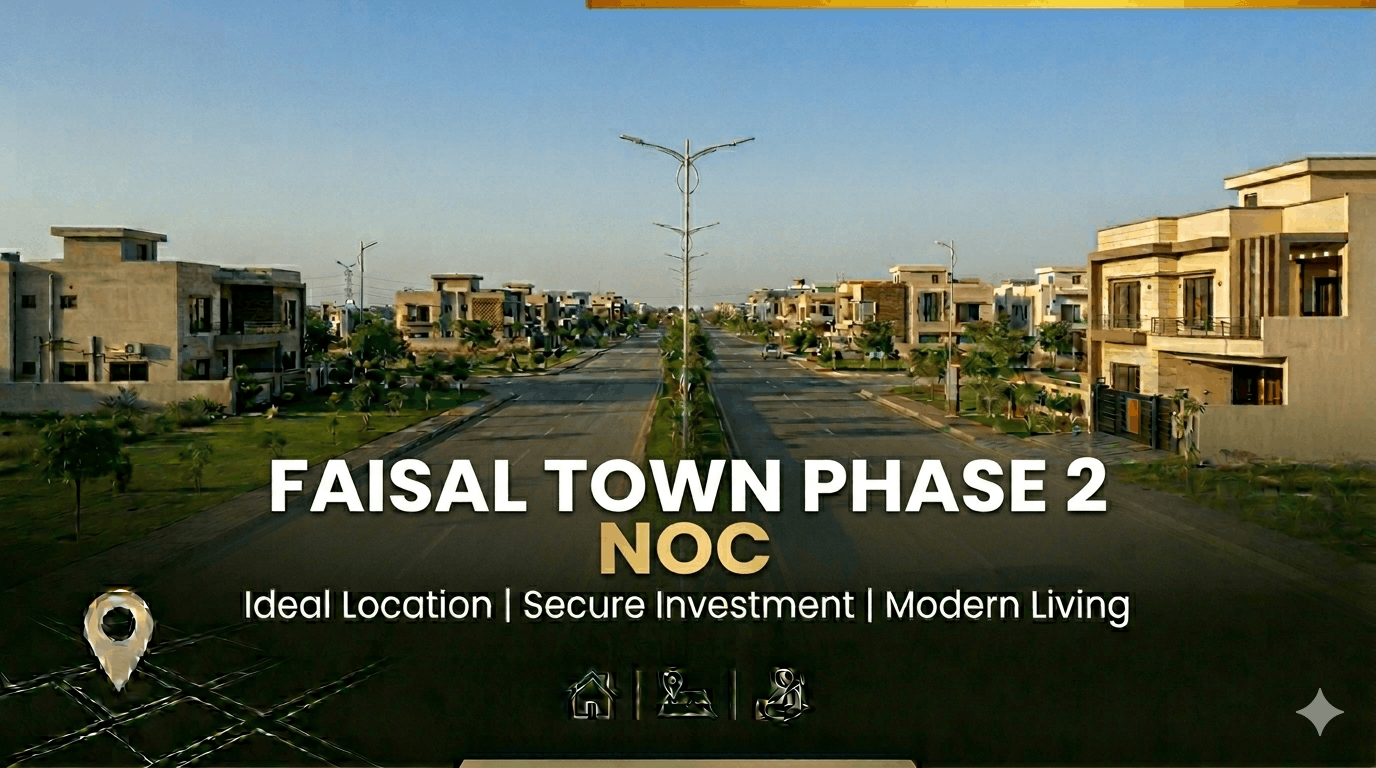
Faisal Town Phase 2 NOC – Complete Legal Status, Approval & Investment Guide
If you are planning to invest in Faisal Town Phase 2, then the very first and most important question you should ask is: “What is the actual NOC status of this project?” Because in Pakistan’s real estate market, a project’s legal approval is not just a formality—it is the foundation of your investment safety, future value, and peace of mind.
Faisal Town Phase 2 has become one of the most talked-about housing projects due to its prime location, development scale, and strong marketing demand. However, like many large-scale societies, investors often feel confused about its legal approval status, especially regarding whether it has received a complete No Objection Certificate (NOC) from the relevant authorities.
Before making any financial decision, it is essential to clearly understand:
- Is Faisal Town Phase 2 fully approved or still under process?
- Which authority is responsible for its legal clearance?
- Is it safe for long-term investment or still carrying risk factors?
- How does it compare with already approved housing societies?
- What are the latest updates and official developments in 2026?
These are not just general questions—they directly impact your investment security and future returns.
In this complete guide, we will break down the Faisal Town Phase 2 NOC status in a simple, clear, and updated way, so you can easily understand the legal position, avoid confusion, and make a smart investment decision based on facts rather than market rumors.
What is Faisal Town Phase 2 NOC?
Meaning of NOC (No Objection Certificate) in Real Estate
In real estate development, an NOC (No Objection Certificate) is an official legal approval issued by a relevant development authority that confirms a housing society is allowed to develop and sell residential or commercial plots. This certificate ensures that the land being used for the project is legally verified, the layout plan is approved, and the development complies with government regulations. In simple words, NOC acts as a legal safety shield for buyers, confirming that the project is not illegal or unauthorized. Without an NOC, a housing project carries higher risk because it may face legal restrictions, delays, or even cancellation in extreme cases.
Why NOC is Important for Housing Societies in Pakistan
In Pakistan’s real estate market, NOC plays a critical role because it directly affects the security of investment and future property value. A society with proper NOC approval is considered safe for buying, selling, and long-term investment. It also increases buyer confidence, improves resale value, and makes it easier to obtain bank financing or loans. On the other hand, societies without clear approval often face uncertainty, which can create risks for investors. That is why experienced buyers always prioritize NOC status before booking any plot in new or developing projects.
Who Issues NOC in Islamabad/Rawalpindi Region
In the Islamabad and Rawalpindi region, the approval and NOC process is managed by official development authorities such as the Rawalpindi Development Authority (RDA) and Capital Development Authority (CDA), depending on the exact location of the project. These authorities are responsible for reviewing land documents, verifying ownership, checking zoning regulations, and approving layout plans. Only after strict verification and compliance checks do they issue final approval or NOC. This process ensures that the housing project follows legal urban planning standards and does not violate any land use rules.
Faisal Town Phase 2 Basic Introduction
Faisal Town Phase 2 is a large-scale residential development project that has gained significant attention in the Islamabad region due to its modern planning, strategic location, and strong market demand. The project is designed to offer residential plots, commercial zones, parks, wide road networks, and modern infrastructure facilities. It is being marketed as a premium housing society that aims to provide a balanced lifestyle with both investment and living opportunities. Due to its rapid growth and investor interest, Faisal Town Phase 2 has become one of the most discussed real estate projects in recent years.
Why Buyers are Concerned About NOC Status
Most buyers show strong interest in Faisal Town Phase 2 but at the same time remain concerned about its NOC status because legal approval directly affects investment safety. In Pakistan’s property market, many projects are launched before final approvals, which creates confusion among investors. Buyers want to ensure that their investment is secure, their files are valid, and their future possession is legally protected. This is why NOC status becomes the most important factor before booking, as it determines whether the project is fully safe or still in the development approval process.
Is Faisal Town Phase 2 Approved or Not? (Latest Legal Status 2026)
Current NOC Status (2026 Update)
As of the latest market situation in 2026, Faisal Town Phase 2 is generally described as a project with ongoing approval processes rather than a fully finalized NOC status across all segments. In many large-scale housing projects, approvals are not issued in a single step; instead, they are granted in phases such as layout approval, land verification, and partial development permissions. This means that while certain documents or development permissions may be in place, the complete final NOC status depends on the completion of all regulatory requirements by the relevant authority.
Official Stance of Relevant Development Authority
The official stance of development authorities like RDA is based strictly on land verification, zoning compliance, and legal documentation. In such projects, authorities usually issue approvals only after ensuring that all land records are clear and the proposed layout plan meets urban development standards. Until the final approval is fully granted, the authority may treat the project as “under process,” which is common in large housing schemes. Therefore, buyers must always rely on official verification rather than market claims or dealer statements.
Difference Between Layout Plan, NOC, and Final Approval
It is very important to understand that layout plan approval, NOC approval, and final land approval are three different stages in the legal process. A layout plan approval only confirms that the proposed design of the society is acceptable, including roads, plots, and infrastructure planning. The NOC approval is a broader clearance that allows the society to legally market and develop the project. Final land approval is the most critical stage where all legal, ownership, and regulatory requirements are fully cleared. Many buyers confuse these stages, which leads to misunderstanding about the actual legal status of the project.
Common Confusion in Market vs Official Facts
In the real estate market, there is often a gap between marketing claims and official documentation. Dealers may present partial approvals as full NOC status, which creates confusion among investors. Some buyers assume that booking availability means full legal approval, which is not always correct. Official facts are only confirmed through development authority records, while market information can sometimes be promotional. This is why it is essential to verify every claim through official channels before making any investment decision.
Authority Responsible for Faisal Town Phase 2 NOC
Role of RDA (Rawalpindi Development Authority)
The Rawalpindi Development Authority (RDA) plays a key role in regulating housing societies within its jurisdiction. Its main responsibility is to ensure that all housing projects follow legal planning standards, land use regulations, and environmental guidelines. For projects like Faisal Town Phase 2, RDA examines land ownership records, verifies zoning compliance, and evaluates the submitted layout plan before issuing any form of approval. Without RDA clearance, a housing project cannot be considered fully legal in the Rawalpindi region.
Role of CDA (If Applicable)
In cases where a housing project falls under Islamabad jurisdiction, the Capital Development Authority (CDA) becomes the main regulatory body. CDA ensures strict compliance with Islamabad’s master plan and urban development rules. It reviews all technical, legal, and environmental aspects before granting approval. Depending on the exact location of Faisal Town Phase 2, CDA involvement may also be relevant in coordination with other regulatory bodies.
Punjab Housing Authority Rules Overview
Apart from RDA and CDA, broader regulations from Punjab housing authorities also apply to ensure standardized development practices. These rules cover land acquisition, environmental impact, road networks, and infrastructure planning. The purpose of these regulations is to maintain transparency and protect investors from illegal or unplanned housing schemes. Every large-scale society must align with these rules before receiving final approval.
Step-by-Step Approval Process Explained
The approval process for a housing society is structured and time-consuming. It begins with land verification, where authorities check ownership documents and ensure there are no disputes. After that, the layout plan is submitted, showing the design of roads, plots, parks, and commercial areas. Once the layout is reviewed, technical approval is granted after evaluating infrastructure planning and compliance standards. The final stage is NOC issuance, which confirms that the project is legally approved for development and marketing. Each stage requires careful evaluation, which is why approvals often take significant time in large projects.
Latest Updates About Faisal Town Phase 2 NOC (2026)
Recent Developer Announcements
In 2026, developers of Faisal Town Phase 2 continue to highlight ongoing progress in development work, infrastructure planning, and documentation processing. While promotional updates often emphasize rapid development and strong demand, official legal confirmation always depends on authority approvals. Developers usually share progress updates regarding road work, plot development, and booking activity to maintain investor confidence and market momentum.
Government Authority Updates
Government authorities generally release updates based on verification progress and compliance reviews. In many cases, updates are not publicly frequent but are processed internally through documentation and inspection reports. If any objections or corrections are required, they are communicated to developers for compliance before final approval is granted.
Progress in Documentation and Land Verification
One of the most important factors in the approval process is land verification. Authorities carefully review land ownership records to ensure that all plots included in the project are legally acquired. In large housing schemes, this step can take time due to the size of land parcels and documentation complexity. However, once verification is complete, the approval process moves closer to finalization.
Market Rumors vs Official Confirmation
The real estate market often generates rumors regarding NOC approval timelines, but not all of these claims are officially verified. Some updates may circulate based on speculation or dealer information. Official confirmation always comes from the relevant authority such as RDA or CDA. Therefore, investors should always rely on verified documentation rather than informal market discussions.
Expected Timeline for Final Approval
The expected timeline for final approval in such large-scale projects depends on multiple factors including documentation completion, land clearance, and authority review schedules. While developers may estimate progress, the final decision always rests with regulatory bodies. Therefore, investors should consider both short-term market movement and long-term legal clarity before making investment decisions.
Why NOC Status is Important Before Investing in Faisal Town Phase 2
Legal Protection of Buyers
NOC status plays a fundamental role in protecting buyers legally because it confirms that the housing society is officially recognized by the relevant development authority. When a project has proper approval, buyers gain confidence that their investment is secured under legal framework and their land or plot file has valid recognition. In contrast, without confirmed NOC, buyers may face uncertainty regarding ownership rights, possession timelines, and future legal standing. That is why legal protection is the first and most important reason investors closely monitor Faisal Town Phase 2 NOC status before making any booking decision.
Risk of Illegal or Unapproved Societies
One of the biggest concerns in Pakistan’s real estate market is the existence of unapproved or partially approved housing societies. If a project does not have complete NOC clearance, it may fall under regulatory scrutiny, which can result in restrictions on development or even warnings from authorities. Investors in such cases face uncertainty because the legality of the project is not fully secured. Therefore, understanding the approval status of Faisal Town Phase 2 helps buyers avoid potential risks associated with illegal or non-compliant developments.
Bank Financing Eligibility
NOC approval is also essential for financial institutions such as banks and housing finance companies. Most banks only provide home loans or plot financing for projects that are fully approved by the relevant authorities. If a housing society lacks complete NOC status, it becomes difficult or sometimes impossible to get bank financing. This directly impacts buyers who rely on installment plans or loans for investment. Therefore, Faisal Town Phase 2 approval status becomes a deciding factor for financial accessibility.
Resale Value Impact
The resale value of any property is strongly linked with its legal status. Approved housing societies usually have higher demand in the secondary market because buyers feel secure purchasing verified plots. On the other hand, projects without full approval often face slower resale activity and price fluctuations. This means that Faisal Town Phase 2 NOC status directly influences how easily an investor can sell or transfer their property in the future and at what price.
Long-Term Development Security
Long-term development security refers to the assurance that a housing project will continue to develop without legal interruptions. When a society has complete approval, developers can legally construct infrastructure such as roads, utilities, and commercial areas without restrictions. This ensures smooth progress and timely delivery. Without full NOC, development may face delays or limitations, which can affect investor confidence and project completion timelines.
Risk Factors If Project is Not Fully Approved
If Faisal Town Phase 2 is not fully approved at any stage, investors may face several risk factors including delays in possession, changes in layout planning, or legal notices from authorities. In some cases, additional documentation or compliance requirements may slow down development progress. These risks do not necessarily mean the project is unsafe, but they highlight the importance of verifying legal status before investment to avoid future complications.
Risks of Investing Without Full NOC Approval
Possibility of Delays in Possession
One of the most common risks in unapproved or partially approved projects is delay in possession. When NOC is not fully granted, development work may be slowed down or temporarily paused due to regulatory checks. This directly impacts the timeline promised to investors, leading to uncertainty in when they will actually receive their plots or property.
Legal Disputes or Land Acquisition Issues
Without complete approval, there is always a possibility of legal disputes regarding land ownership or acquisition. Authorities may request additional verification or clarification, which can create complications for developers and investors. These disputes may take time to resolve, affecting overall project stability.
Restricted Development Permissions
If a project is not fully approved, developers may face restrictions on construction activities. This can limit infrastructure development such as road networks, utility installation, and commercial expansion. As a result, the overall growth of the society may slow down until full compliance is achieved.
Difficulty in Resale or Transfer
Properties in non-approved or under-process societies often face difficulty in resale. Buyers in the secondary market prefer legally secure investments, so demand may be lower compared to approved societies. This can also result in longer selling time and reduced bargaining power for sellers.
Potential Government Action or Warnings
In some cases, if a housing society fails to meet regulatory requirements, government authorities may issue warnings or notices. This can create uncertainty among investors and affect market reputation. Although not common in all cases, it remains a possible risk in projects without final approval.
Investor Confidence Impact
Investor confidence is directly linked to legal clarity. When NOC status is unclear or incomplete, investors may hesitate to invest or expand their holdings in the project. This can slow down market activity and affect price stability in the short term.
Faisal Town Phase 2 vs Approved Housing Societies (Comparison)
Comparison with Fully Approved Societies in Islamabad/Rawalpindi
Fully approved housing societies in Islamabad and Rawalpindi offer complete legal protection, stable development, and strong regulatory backing. In comparison, projects like Faisal Town Phase 2 may still be in development or approval stages, which creates a difference in perceived security. Approved societies are generally considered safer, while emerging projects offer higher early-stage opportunity.
Price Difference vs Legal Security
One of the main differences between approved and developing societies is pricing. Early-stage projects often offer lower prices and flexible payment plans, attracting investors looking for growth potential. However, fully approved societies usually have higher prices due to legal security and completed development status. Investors must balance affordability with safety when making decisions.
Development Speed Comparison
Approved societies usually have faster and more stable development because all legal permissions are already in place. In contrast, developing projects may experience variable construction speed depending on approval progress. This difference can impact possession timelines and overall project completion.
Risk vs Reward Analysis
Investing in approved societies offers lower risk but moderate returns, while investing in developing projects like Faisal Town Phase 2 may offer higher potential returns but with increased risk. This trade-off is important for investors to understand before making financial commitments.
Infrastructure and Planning Comparison
Approved societies generally have fully established infrastructure planning, including roads, utilities, and commercial zones. Developing societies are still in the process of building this infrastructure, which means long-term growth potential exists but immediate facilities may be limited.
Which Option is Better for Safe Investment
For risk-averse investors, fully approved societies are usually the safer choice due to legal clarity and stable development. However, for investors focused on long-term gains and early entry advantages, Faisal Town Phase 2 may still offer attractive opportunities if they carefully evaluate legal status and project progress.
How to Verify Faisal Town Phase 2 NOC Yourself
Visit Official RDA/CDA Website
The first and most reliable method to verify NOC status is by visiting the official website of the relevant development authority such as RDA or CDA. These platforms often provide updated lists of approved housing societies where investors can check whether Faisal Town Phase 2 is included in the approved category or still under process.
Ask for NOC Documents from Dealer or Developer
Investors should always request official NOC or approval documents directly from the developer or authorized dealers. Genuine developers usually provide verification documents that can be cross-checked with authority records. This step helps avoid misinformation in the market.
Verify Layout Plan Approval Status
Layout plan approval is an important part of the verification process. Buyers should confirm whether the society’s layout plan has been officially approved, as this indicates the project has passed an important regulatory stage even if final NOC is still in process.
Cross-Check File Number Authenticity
Each plot or file in a housing society usually has a unique identification number. Investors should cross-check this file number with official records or authorized representatives to ensure authenticity and avoid fraudulent files.
Visit Society Site Office
Visiting the physical site office is another practical step for verification. It allows buyers to directly interact with official representatives, view documentation, and understand the development progress on ground.
Consult Legal Property Expert Before Booking
For added security, consulting a legal property expert or real estate advisor is highly recommended. Experts can analyze documents, verify approval status, and guide investors about potential risks before making any financial commitment.
Investment Potential of Faisal Town Phase 2 Despite NOC Status
Location Advantage and Connectivity
Faisal Town Phase 2 benefits from a strong location advantage with access to major road networks and nearby urban developments. Good connectivity plays a key role in long-term value appreciation, making it attractive for future residential and commercial demand.
Developer Reputation Impact on Market Trust
The reputation of the developer significantly influences market confidence. Established developers with a strong track record usually attract more investors even in early-stage projects because buyers trust their delivery history and project execution capabilities.
Early Investment Benefits
Early investment in developing projects often provides lower entry prices and flexible payment plans. Investors who enter at early stages can benefit from significant price appreciation as the project develops and gains approval stability.
Expected Future Price Appreciation
As development progresses and legal approvals become clearer, property values generally increase. Faisal Town Phase 2 has strong potential for future price appreciation if development and legal processes continue in a positive direction.
Demand Trends in Islamabad Region
The Islamabad and Rawalpindi real estate market continues to show strong demand due to population growth and urban expansion. This demand supports long-term investment potential for well-planned housing projects.
Long-Term Investment Perspective
From a long-term perspective, Faisal Town Phase 2 can be considered an opportunity-driven investment. However, investors should always balance potential returns with legal clarity and conduct proper due diligence before investing.
FAQs About Faisal Town Phase 2 NOC
Is Faisal Town Phase 2 completely approved?
It is generally considered to be in an ongoing approval or development stage, and investors should verify the latest official status before booking.
Which authority gives NOC for Faisal Town Phase 2?
The relevant authority is typically RDA or CDA depending on jurisdiction and land location.
Is it safe to invest without full NOC?
It can offer potential growth but carries higher risk compared to fully approved societies, so verification is essential.
When will final NOC be expected?
There is no fixed public timeline; it depends on land verification and authority approvals.
Can I get file transfer without NOC approval?
Yes, transfers may happen in some cases, but legal security depends on final approval status.
Conclusion – Should You Invest in Faisal Town Phase 2?
Faisal Town Phase 2 represents a growing real estate opportunity with strong location benefits, developer reputation, and long-term market demand.
However, like many large-scale projects in Pakistan, its investment safety is closely linked with its NOC and approval status.
Before making any decision, it is important to clearly verify legal documents, understand the current approval stage, and avoid relying only on market claims.
For investors, the key is balance—while the project may offer attractive early-stage returns and future price growth, it also requires careful due diligence due to evolving legal status.
A smart investment decision should always combine opportunity with security, ensuring that your capital is protected while still benefiting from future market appreciation.

Recent Posts

Faisal Hills Booking – Your Complete Guide to Plot Booking in Islamabad & Rawalpindi
Faisal Town Phase 2 Location (Complete Guide for Buyers & Investors 2026)